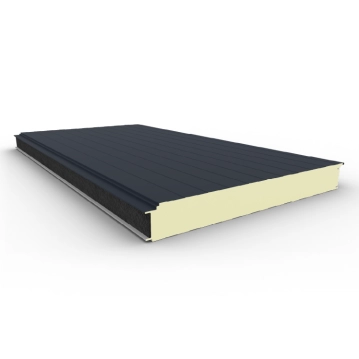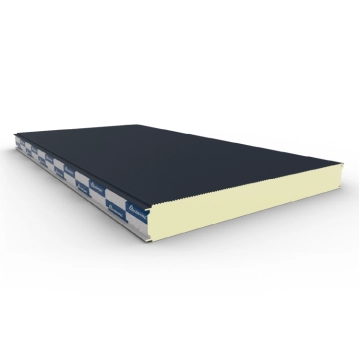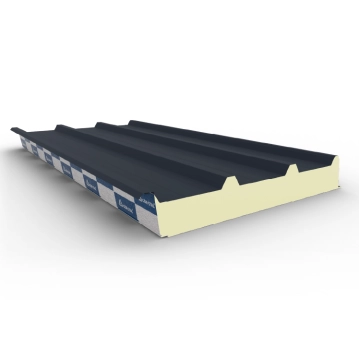






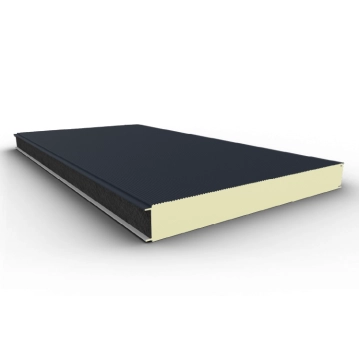
PIR sandwich panels for walls and roof panels
Nowadays, it is difficult to imagine construction—especially industrial, agricultural, and warehouse buildings (storage facilities, cold stores, freezers, and livestock buildings)—without the use of sandwich panels. Fast and easy installation, the ability to work even in difficult weather conditions, low investment costs, and the modern, versatile nature of the system make them an excellent construction material.
Sandwich panels consist of two facings and an insulating core with appropriate thermal and mechanical properties.
The facings are made of double-sided galvanized steel sheet coated with an organic polyester lacquer with a thickness of 25 microns. Gór-Stal has been cooperating for years with renowned European and Asian steel mills. The coated steel undergoes continuous quality control both after each production stage at the mills and upon delivery to the warehouse in Gorlice.
Wall Sandwich Panels
When choosing wall sandwich panels for external wall construction, in addition to parameters such as energy efficiency (energy savings and thermal insulation) and resistance to high temperatures (fire resistance), it is also important to consider properties such as durability and watertightness, corrosion resistance, air permeability, and thermal loads on the external facings.
The unique PIR foam formulation, the high quality of steel used for facings, and precisely manufactured installation accessories ensure safety and stable mechanical and insulation performance for Gór-Stal sandwich panels.
Roof Sandwich Panels
Roof sandwich panels are ideal for covering industrial and warehouse buildings. When selecting them, the following parameters should be considered: load-bearing capacity and structural performance, resistance to point loads, strength, impact resistance, fire resistance, sound insulation, energy efficiency, durability, watertightness, and corrosion resistance.
Cold Storage Sandwich Panels
Cold storage sandwich panels are a special type of sandwich panel designed for buildings with temperatures as low as -40°C. They are manufactured from materials resistant to low temperatures and deformation. They also meet all sanitary requirements and ensure airtightness as well as protection against mold and fungi.